I recently read an article in National Geographic concerning the rainforests of Borneo and the drastic deforestation that is going on there. I think that this issue is one of those issues that almost no one in the general population has heard of and when they do hear it, they think to themselves “how does the rainforest in Borneo affect me?” The answer is it affects us all, a lot, in ways which we cannot imagine, or possibly do not want to imagine.
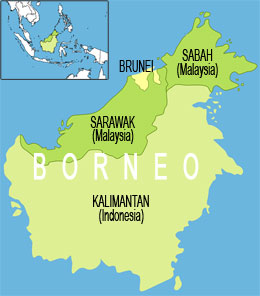 The island of Borneo is split into sections governed by different countries: Indonesia, Malaysia, and Brunei. Unfortunately two of the three countries have experienced years of corrupt government who have allowed illegal logging to take place. Not only that, but these governments have used these forests as their own personal playgrounds in order to make themselves and their friends and family wealthy from proceeds of logging, mining (gold and coal), and palm oil production. The small area which Brunei governs is the exception, as the government of Brunei has largely left the forests alone as a result of revenues they receive from the production of petroleum products. The governments of Malaysia and Indonesia have squandered these forests, which, like all rainforests, release high levels of oxygen into our atmosphere. In addition to the production of oxygen, rainforests are a gold mine of animals, plants, birds, insects, and reptiles who have untold value, in ways yet undiscovered, which may never be discovered, as they are made endangered by this deforestation.
  Ironically, as these forests are being taken from us, plantations of oil palms are planted in order to harvest palm oil. Palm oil is used in many different industries, but one major industry that uses palm oil is the biodiesel industry. The growing of these palms for this purpose not only encourages the deforestation of these rainforests, but also the process of making the land ready for planting of the palms releases large amounts of carbon into the atmosphere, contributing to the very climate change problem for which biodiesel is being produced as a solution. Borneo’s soil contains large amounts of peat moss which, when burned, releases large amounts of carbon, contributing to the problem of carbon levels in the atmosphere, thus making it seem that the production of biodiesel using this palm oil is counterproductive to its intent. The problem is palm oil is big money, and money is something the people of Borneo need. While the palm oil fields, strip mines, and burning forests cause humanitarian problems and environmental problems, it brings in some of the only revenue Borneo sees, making it hard for its residents to see the bigger picture or even care about the bigger picture.
It is hard for the US to preach to Borneo about saving its lands and forests when government officials are pushing for us to drill in our own national parks and our preserve land. Also, the US is a nation who has depleted large amounts of its own natural resources, torn down its trees, and polluted its water. We can hope that because of our own realizations of what depletion and destruction of resources can mean to the bigger picture that we may be able to help Borneo to learn from our mistakes. We can also hope that our upcoming administration will not only be an advocate for places like Borneo, but for our own remaining parks and preserve land as well. It is my hope that we, as a country, will all become educated on this situation and others like it so that we may all contribute to the solution rather than continue being part of the problem. It would also be a very big step towards the solution if President Obama, and other world leaders, will support REDD and help the world find a way to balance the needs of the people of Borneo with the world’s need of their forests.
*photos from: Destination 360 ; Mongabay.com ; and Rainforests @ Mongabay.com


No comments:
Post a Comment